
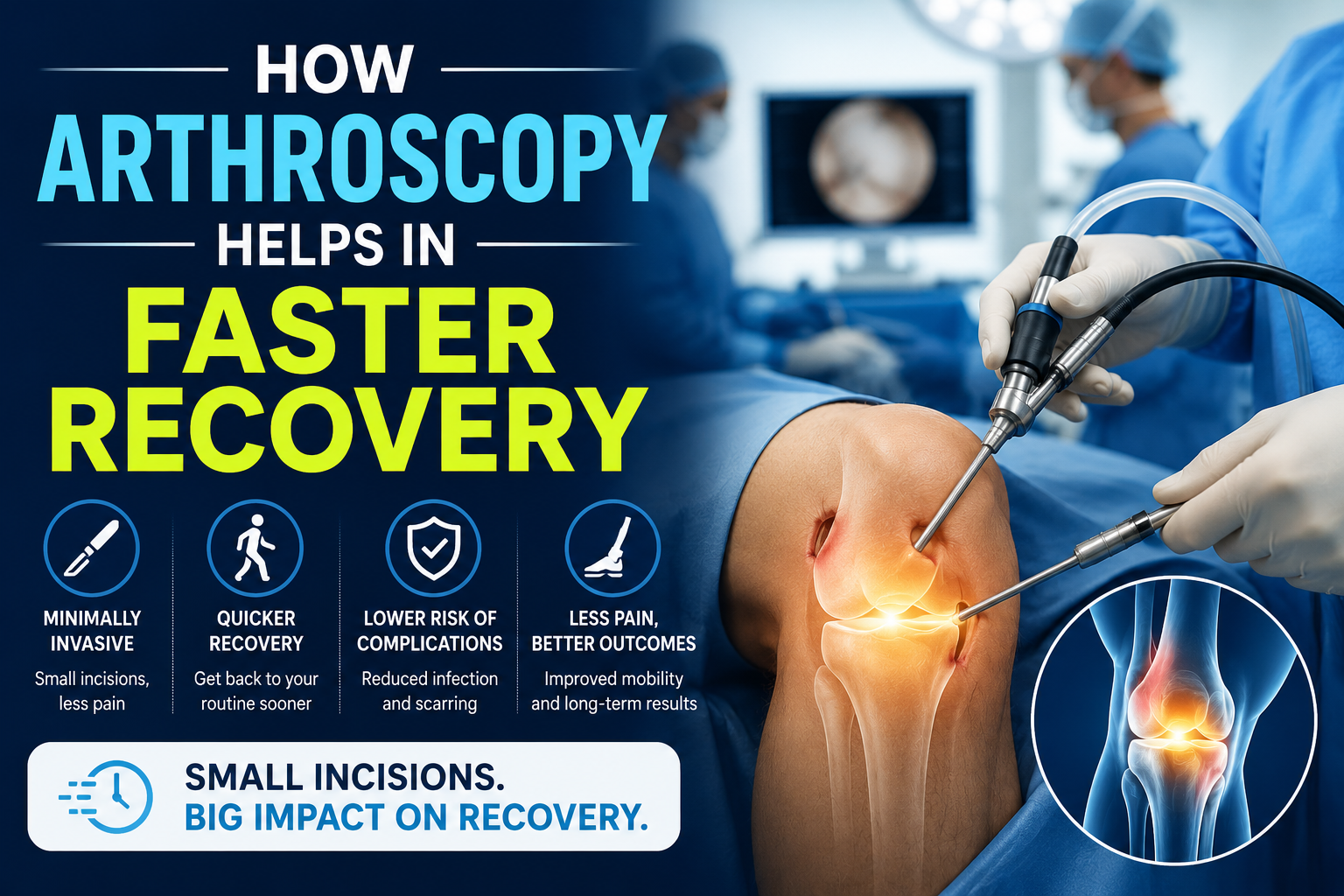
Joint pain and sports injuries can sometimes make everyday activities difficult. A torn meniscus, damaged cartilage, ligament injury, or certain other joint problems may require a surgical procedure when conservative treatment does not provide enough improvement.
One minimally invasive technique used for diagnosing and treating selected joint conditions is arthroscopy.
Arthroscopy uses a small camera called an arthroscope to look inside a joint. The surgeon can also insert specialized instruments through small incisions to treat certain problems.
Because arthroscopy uses small incisions compared with traditional open surgery, recovery can often be quicker for appropriate procedures. However, recovery time depends greatly on the joint involved, the condition being treated, the procedure performed, and the patient’s overall health.
Let’s understand how arthroscopy works and why it may support recovery.
What Is Arthroscopy?
Arthroscopy is a minimally invasive surgical technique used to examine and, when appropriate, treat problems inside a joint.
The surgeon makes small incisions called portals around the joint. A small camera is inserted through one of these openings. The camera projects an enlarged image onto a screen, allowing the surgeon to examine structures inside the joint.
Special instruments can be inserted through additional small portals.
Arthroscopy is commonly performed on joints such as:
- Knee
- Shoulder
- Ankle
- Elbow
- Wrist
- Hip
The exact procedure depends on the joint and the patient’s diagnosis.
For example, knee arthroscopy may be used to treat selected meniscus tears and other internal knee problems. In meniscus surgery, arthroscopic instruments can be used either to trim damaged tissue or repair certain tears when repair is appropriate.
Why Is Arthroscopy Considered Minimally Invasive?
Traditional open surgery may require a larger incision to access the affected area.
Arthroscopy generally uses several small openings instead.
This can mean:
- Smaller surgical wounds
- Less disruption of surrounding tissues
- Potentially less postoperative discomfort for appropriate procedures
- Earlier movement in selected cases
- Faster return to certain daily activities
The American Academy of Orthopaedic Surgeons notes that recovery from arthroscopy is generally faster than recovery from open surgery, although the joint may still require several weeks to completely recover.
It is important to understand that “minimally invasive” does not mean “instant recovery.”
The internal tissues still need time to heal.
How Does Arthroscopy Help With Recovery?
1. Smaller Incisions
One of the most obvious advantages of arthroscopy is the smaller surgical access points.
Smaller incisions may reduce the amount of tissue disruption required to reach the joint.
This can contribute to a more comfortable early recovery in appropriate patients.
However, the size of the incision is only one factor affecting recovery. The type of repair performed inside the joint can have an even greater influence on how long rehabilitation takes.
2. Less Soft-Tissue Disruption
Arthroscopy allows surgeons to access the joint using specialized instruments rather than creating a large opening.
The surgeon can view the joint directly on a monitor and work with precision.
This approach may help limit unnecessary disturbance to surrounding tissues.
That can be particularly useful when treating selected sports-related injuries and internal joint problems.
3. Earlier Movement
Movement is an important component of many orthopedic rehabilitation programs.
Depending on the procedure, patients may be encouraged to begin controlled movement relatively soon after surgery.
The exact instructions vary.
For example, a patient who undergoes a simple arthroscopic procedure may have a different rehabilitation program from someone who has a ligament reconstruction or meniscus repair.
Your surgeon and physiotherapist will determine when movement and weight-bearing should begin.
4. Faster Return to Daily Activities in Selected Cases
One reason patients choose minimally invasive procedures when appropriate is the possibility of returning to normal activities sooner.
After some arthroscopic procedures, patients may be able to return to light daily activities within a relatively short period.
The AAOS notes that it is not unusual for some patients to resume daily activities and return to work or school within a few days following arthroscopy, although heavy physical work may require more time.
This should not be interpreted as a universal recovery timeline.
A professional athlete recovering from ligament reconstruction, for example, may require significantly more rehabilitation than someone undergoing a simpler procedure.
5. Reduced Dependence on Large Surgical Wounds
Large surgical wounds require healing.
Arthroscopy’s small portals can make wound care simpler in many cases.
Patients still need to follow their surgeon’s instructions regarding:
- Dressing care
- Keeping the wound clean
- Showering
- Exercise
- Weight-bearing
- Driving
- Returning to work
- Sports participation
Ignoring postoperative instructions can delay recovery even after a minimally invasive procedure.
Arthroscopy for Meniscus Injuries
The meniscus is a C-shaped piece of cartilage inside the knee that helps absorb shock and contributes to joint stability.
A meniscus tear can occur during sports, twisting movements, falls, or as a result of degenerative changes.
Treatment depends on factors such as:
- Patient age
- Type of tear
- Location of the tear
- Symptoms
- Activity level
- Associated injuries
- Overall condition of the knee
Some meniscus injuries can be treated without surgery.
When surgery is appropriate, arthroscopy may be used to trim damaged tissue or repair a tear.
Arthroscopy and Sports Injuries
Athletes often require treatment that allows them to eventually return to their desired activity.
Arthroscopy can be used for selected injuries involving structures inside joints.
However, the goal should not simply be to return to sport as quickly as possible.
The joint must heal properly.
Returning too early can increase the risk of reinjury.
A structured rehabilitation program may include:
- Range-of-motion exercises
- Muscle strengthening
- Balance training
- Movement retraining
- Gradual loading
- Sport-specific exercises
- Functional testing
The Role of Physiotherapy After Arthroscopy
Surgery is only one part of recovery.
Physiotherapy can be equally important.
After an appropriate arthroscopic procedure, your physiotherapist may help you progressively restore movement and strength.
A typical rehabilitation program may focus on:
Range of Motion
The goal is to restore safe joint movement while protecting healing tissues.
Muscle Strength
Pain and inactivity can cause muscles around the joint to become weak.
Strengthening helps restore stability and function.
Balance and Coordination
These are especially important after lower-limb injuries.
Functional Training
Patients eventually need to perform real-world movements such as walking, climbing stairs, squatting, reaching, or changing direction.
Return-to-Sport Training
Athletes may require sport-specific rehabilitation before returning to competition.
Why Recovery Time Is Different for Everyone
A common misconception is that every arthroscopy patient recovers within the same number of days or weeks.
This is not true.
Recovery depends on several factors.
Type of Procedure
A simple arthroscopic procedure may have a relatively short rehabilitation period.
A ligament reconstruction or meniscus repair can require considerably more rehabilitation.
Severity of Injury
A small isolated injury may recover differently from a complex injury involving multiple structures.
Age and Overall Health
General health, muscle strength, fitness, and other medical conditions can influence recovery.
Rehabilitation
Patients who follow their prescribed rehabilitation program generally have a more structured path toward regaining strength and mobility.
Activity Demands
Someone with a desk job may return to work earlier than someone whose job requires heavy lifting, climbing, or prolonged standing.
Is Arthroscopy Always Better Than Open Surgery?
Not necessarily.
Arthroscopy is an excellent technique for many appropriately selected conditions, but it is not suitable for every orthopedic problem.
Some injuries or conditions require open surgery or another treatment approach.
The correct procedure depends on the patient’s diagnosis.
An orthopedic surgeon may recommend:
- Medication
- Physiotherapy
- Activity modification
- Injections in selected cases
- Arthroscopy
- Open surgery
- Joint replacement
- Other specialized procedures
The objective should always be to select the treatment that best addresses the underlying problem.
What Can You Do to Recover Faster?
While your surgeon determines the medical rehabilitation plan, patients can support recovery by following a few important principles.
Follow Your Postoperative Instructions
Do not increase activity simply because your pain has improved.
Pain reduction does not always mean that internal tissues have completely healed.
Complete Your Physiotherapy
Skipping rehabilitation exercises may result in weakness or stiffness.
Perform your exercises according to your physiotherapist’s instructions.
Avoid Premature Sports
Returning to sports before your joint has recovered can increase the risk of injury.
Your surgeon or physiotherapist should guide your return to activity.
Maintain a Healthy Lifestyle
Adequate nutrition, appropriate activity, sleep, and avoiding harmful habits can support general recovery.
Attend Follow-Up Appointments
Follow-up appointments allow your surgeon to assess healing and modify your rehabilitation plan when necessary.
What Are the Risks?
Arthroscopy is generally considered a safe procedure, but every surgery has potential risks.
Possible complications include:
- Infection
- Blood clots
- Bleeding
- Excessive swelling
- Damage to nerves or blood vessels
- Persistent pain
- Stiffness
- Problems related to anesthesia
The AAOS notes that most patients do not experience complications, but potential risks should still be discussed with the treating surgeon.
Final Thoughts
Arthroscopy has changed the way many joint problems are diagnosed and treated.
By using small incisions and specialized instruments, it allows surgeons to access certain areas of a joint while minimizing the amount of surgical exposure required.
For appropriately selected patients, this can support a more comfortable recovery and an earlier return to daily activities.
However, arthroscopy is not a shortcut around healing.
The success of recovery depends on the underlying injury, procedure performed, patient health, and commitment to rehabilitation.
If you have persistent joint pain, swelling, locking, instability, or difficulty returning to normal activities after an injury, an orthopedic evaluation can help determine the cause and identify appropriate treatment options.
The goal of arthroscopy is not simply smaller incisions. The real goal is to restore joint function safely and help the patient return to an active life.
Medical disclaimer: This article is for educational purposes only. Arthroscopy is not appropriate for every joint condition. Diagnosis and treatment should be determined by a qualified orthopedic specialist after appropriate clinical evaluation.