
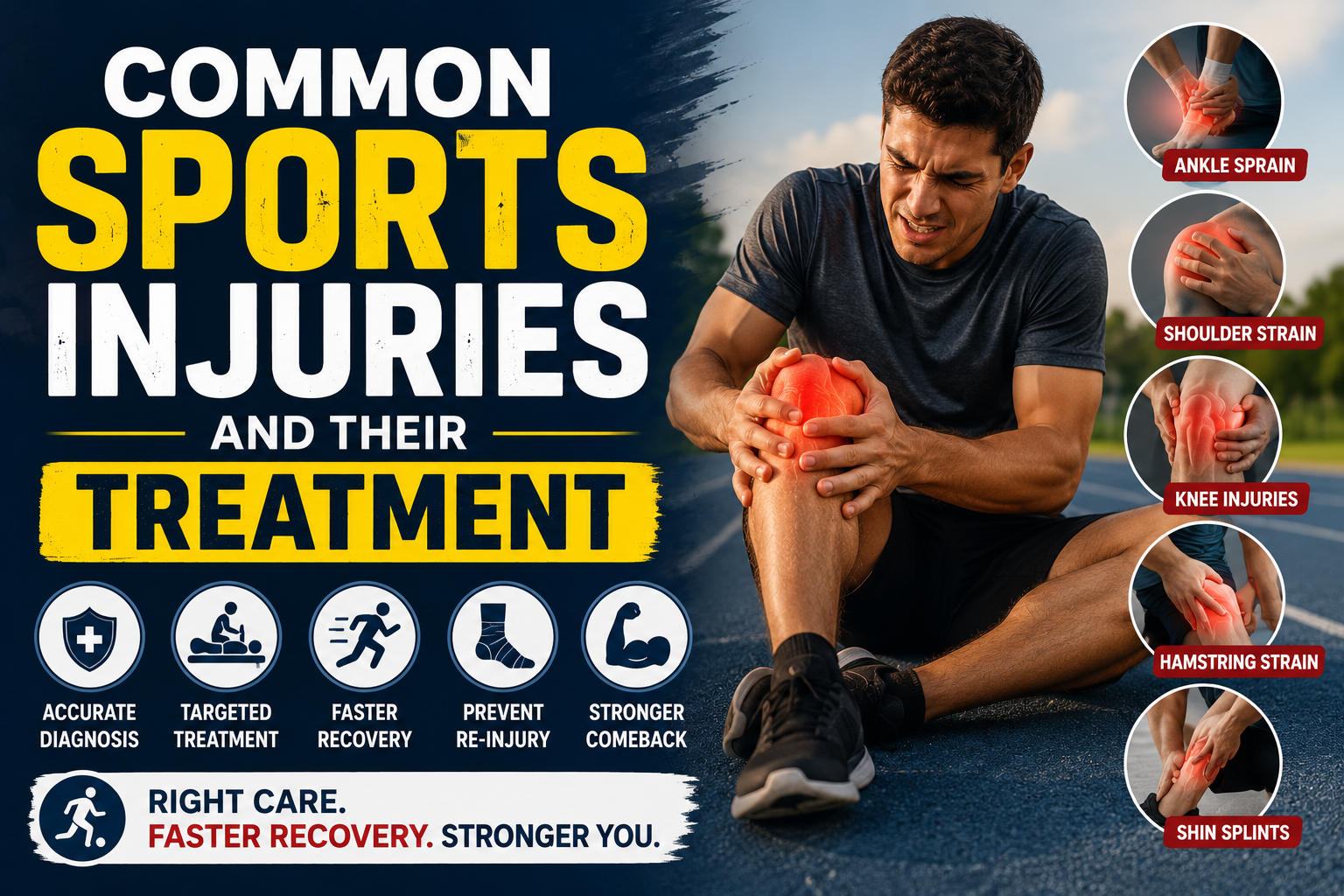
Sports and physical activity are excellent ways to stay fit, strong, and active. Whether you enjoy cricket, football, badminton, running, gym workouts, cycling, or recreational sports, movement offers many physical and mental benefits.
However, sports also place stress on muscles, bones, tendons, ligaments, and joints. An awkward landing, sudden change in direction, collision, overuse, or incorrect training technique can result in an injury.
Some sports injuries are minor and improve with rest and rehabilitation. Others may require medical treatment, imaging, physiotherapy, or surgery.
Understanding common sports injuries can help athletes recognize symptoms early and seek appropriate care.
1. Sprains
A sprain occurs when a ligament is stretched or torn.
Ligaments are strong bands of tissue that connect bones and help stabilize joints.
Sprains commonly occur in:
- Ankle
- Knee
- Wrist
- Thumb
An ankle sprain is particularly common in sports involving running, jumping, or rapid changes of direction.
Symptoms may include:
- Pain
- Swelling
- Bruising
- Tenderness
- Difficulty putting weight on the affected area
- Joint instability in more severe injuries
Treatment depends on the severity of the sprain.
Mild injuries may improve with rest, appropriate activity modification, ice or other symptom-management strategies, compression, elevation, and rehabilitation.
More serious ligament injuries may require imaging, bracing, physiotherapy, or surgery depending on the specific ligament and degree of damage.
2. Muscle Strains
A strain affects a muscle or tendon.
Strains can occur when a muscle is suddenly stretched beyond its normal capacity or is overloaded during activity.
Common locations include:
- Hamstrings
- Calf muscles
- Groin
- Lower back
- Shoulder muscles
Athletes may experience sudden pain during sprinting, jumping, lifting, or explosive movements.
A mild strain may cause soreness and discomfort, while a more severe tear can cause significant pain, weakness, swelling, and difficulty using the affected muscle.
Treatment often focuses on reducing aggravating activity initially, followed by progressive rehabilitation.
A physiotherapist can help restore flexibility and strength before the athlete returns to full activity.
3. ACL Injuries
The anterior cruciate ligament, commonly known as the ACL, is one of the major stabilizing ligaments of the knee.
ACL injuries are particularly common in sports involving sudden stopping, pivoting, jumping, or changing direction.
They may occur with or without contact.
Symptoms can include:
- A popping sensation at the time of injury
- Sudden knee pain
- Swelling
- Difficulty continuing the activity
- Knee instability
- Difficulty bearing weight
The treatment of an ACL injury depends on several factors, including the patient’s activity level, knee stability, associated injuries, and overall health.
Some patients may be treated with rehabilitation and activity modification.
For active patients with significant instability or certain associated injuries, surgical reconstruction may be recommended.
AAOS guidance notes that treatment decisions for ACL injuries depend on factors including activity level, knee instability, associated injuries, and overall patient circumstances.
4. Meniscus Tears
The meniscus acts as a shock absorber within the knee.
A meniscus tear can occur during a twisting movement or as a result of degenerative changes over time.
Common symptoms include:
- Knee pain
- Swelling
- Catching or locking
- Difficulty bending or straightening the knee
- A sensation that the knee is giving way
Not every meniscus tear requires surgery.
Depending on the symptoms and characteristics of the tear, treatment may include:
- Rest and activity modification
- Physiotherapy
- Medication when appropriate
- Injections in selected cases
- Arthroscopic meniscus repair
- Partial meniscectomy in selected cases
When surgery is required, arthroscopy may allow the surgeon to inspect the joint and repair or trim damaged meniscus tissue.
5. Tendon Injuries
Tendons connect muscles to bones.
Repeated stress can cause tendon irritation or degeneration, while sudden force can sometimes cause a tendon tear.
Common sports-related tendon problems include:
- Achilles tendon injuries
- Patellar tendon injuries
- Rotator cuff injuries
- Tennis elbow
- Jumper’s knee
Treatment depends on the specific tendon and severity of the injury.
Mild tendon problems may improve with activity modification, physiotherapy, strengthening, and gradual return to activity.
A significant tendon tear may require surgical repair.
6. Fractures
A fracture means that a bone has cracked or broken.
Sports-related fractures can occur because of direct impact, falls, twisting forces, or repetitive stress.
Symptoms may include:
- Severe pain
- Swelling
- Bruising
- Deformity
- Inability to use the affected limb
- Difficulty bearing weight
Some fractures can be treated with immobilization using a cast or brace.
Other fractures may require surgery to restore alignment and stability.
Treatment depends on the location and severity of the fracture, as well as the patient’s overall health.
Importantly, pain may improve before the bone is strong enough for unrestricted activity. Rehabilitation may be necessary to restore strength, flexibility, and joint movement.
7. Shoulder Dislocations
The shoulder has a large range of motion, which also makes it vulnerable to instability and dislocation.
A shoulder dislocation can occur during contact sports, falls, or forceful movements.
Symptoms may include:
- Severe shoulder pain
- Visible deformity
- Inability to move the arm normally
- Swelling
- Numbness or tingling
A suspected shoulder dislocation requires prompt medical evaluation.
The joint should not be forcefully manipulated at home.
After the shoulder is repositioned by a medical professional, rehabilitation is often required to restore movement and strength and reduce the risk of future instability.
8. Tennis Elbow
Despite its name, tennis elbow can affect people who do not play tennis.
It involves pain around the outer part of the elbow and is commonly associated with repetitive gripping or wrist movements.
It may affect:
- Tennis players
- Badminton players
- Weightlifters
- Manual workers
- People performing repetitive computer or hand activities
Treatment may include activity modification, physiotherapy, strengthening exercises, and other treatments depending on the severity and duration of symptoms.
9. Runner’s Knee
Runner’s knee is a general term often used for pain around the front of the knee, including patellofemoral pain.
It can occur due to repetitive stress, training errors, muscle weakness, changes in activity, or problems with movement mechanics.
Symptoms may become noticeable during:
- Running
- Squatting
- Climbing stairs
- Jumping
- Sitting for prolonged periods
Treatment commonly focuses on identifying the cause of symptoms and improving strength, flexibility, movement mechanics, and training habits.
10. Stress Fractures
Unlike an acute fracture caused by a single event, a stress fracture is usually associated with repetitive loading.
They can occur when bones are repeatedly exposed to stress without enough time to recover.
Runners and athletes who suddenly increase training volume may be at risk.
Pain may initially occur only during exercise and later become more persistent.
Ignoring a suspected stress fracture and continuing high-impact activity can worsen the injury.
Medical evaluation is important if pain is persistent or repeatedly returns with activity.
How Are Sports Injuries Diagnosed?
The first step is usually a detailed medical history and physical examination.
Your doctor may ask:
- How did the injury occur?
- Was there a twisting movement?
- Did you hear or feel a pop?
- Did swelling appear immediately?
- Can you put weight on the limb?
- Have you had a previous injury?
- What sport do you play?
- What level of activity do you want to return to?
Depending on the suspected injury, imaging may include:
- X-ray
- Ultrasound
- MRI
- CT scan
Not every injury requires advanced imaging.
Your orthopedic specialist will determine what investigations are appropriate.
Treatment Options for Sports Injuries
Rest and Activity Modification
The first step for many minor injuries is reducing activities that aggravate symptoms.
Rest does not always mean complete inactivity.
Your doctor or physiotherapist may recommend safe movements while avoiding activities that overload the injured structure.
Physiotherapy
Rehabilitation is an important component of sports injury treatment.
It may focus on:
- Flexibility
- Strength
- Balance
- Coordination
- Joint movement
- Core stability
- Sport-specific movements
Medication
Depending on the injury, doctors may recommend pain-relieving or anti-inflammatory medications.
Medication should be used according to medical advice, especially if you have other medical conditions or take other medications.
Bracing or Support
Certain injuries may benefit from temporary braces, supports, or immobilization.
The type and duration depend on the injury.
Injections
In selected conditions, a doctor may consider an injection as part of treatment.
The suitability of injections depends on the diagnosis.
Surgery
Surgery may be considered when there is significant structural damage or when appropriate non-surgical treatment has not restored adequate function.
Examples can include:
- ACL reconstruction
- Meniscus repair
- Tendon repair
- Fracture fixation
- Shoulder stabilization
The decision should be individualized.
How Can Sports Injuries Be Prevented?
Although not every injury can be prevented, athletes can reduce risk by following good training principles.
Warm Up Properly
Begin activity gradually.
A warm-up prepares the body for exercise and allows athletes to transition from rest to higher-intensity activity.
Increase Training Gradually
Avoid sudden increases in training volume or intensity.
Your body needs time to adapt.
Strengthen Supporting Muscles
Strong muscles can help support joints and improve movement control.
Work on Flexibility and Mobility
Maintaining appropriate flexibility can support efficient movement.
Use Proper Technique
Poor technique can increase unnecessary stress on muscles and joints.
Coaches and physiotherapists can help identify technique problems.
Wear Appropriate Equipment
Proper footwear and sport-specific protective equipment can help reduce injury risk.
Allow Recovery
Rest days are part of training.
Recovery allows tissues to adapt to physical stress.
When Should You See an Orthopedic Specialist?
Seek professional evaluation if you have:
- Severe pain
- Significant swelling
- Deformity
- Inability to bear weight
- Persistent pain
- Recurrent instability
- Joint locking
- Loss of movement
- Symptoms that are getting worse
- Pain that repeatedly returns when you resume sport
Early evaluation can help identify the injury and establish an appropriate treatment and rehabilitation plan.
Returning to Sport After Injury
Returning to sport should be gradual.
The athlete should ideally have adequate:
- Pain control
- Range of motion
- Muscle strength
- Balance
- Coordination
- Joint stability
- Sport-specific ability
Returning simply because pain has decreased may not be enough.
A physiotherapist or sports medicine professional can help determine whether the athlete is ready for higher levels of activity.
Final Thoughts
Sports injuries can affect anyone, from professional athletes to people who exercise recreationally.
Sprains, strains, ACL injuries, meniscus tears, tendon problems, fractures, and overuse injuries all require different approaches.
The most important step is to understand that not every sports injury requires surgery, but not every injury should be ignored either.
If pain persists, movement is restricted, the joint feels unstable, or symptoms repeatedly return, seek an orthopedic evaluation.
With the right diagnosis, treatment, rehabilitation, and gradual return to activity, many athletes can work toward safely returning to the activities they enjoy.
Listen to your body, treat injuries early, and give your body enough time to recover before returning to full sports activity.
Medical disclaimer: This article is for educational purposes and does not replace an individual examination by an orthopedic surgeon, sports medicine specialist, or physiotherapist.