
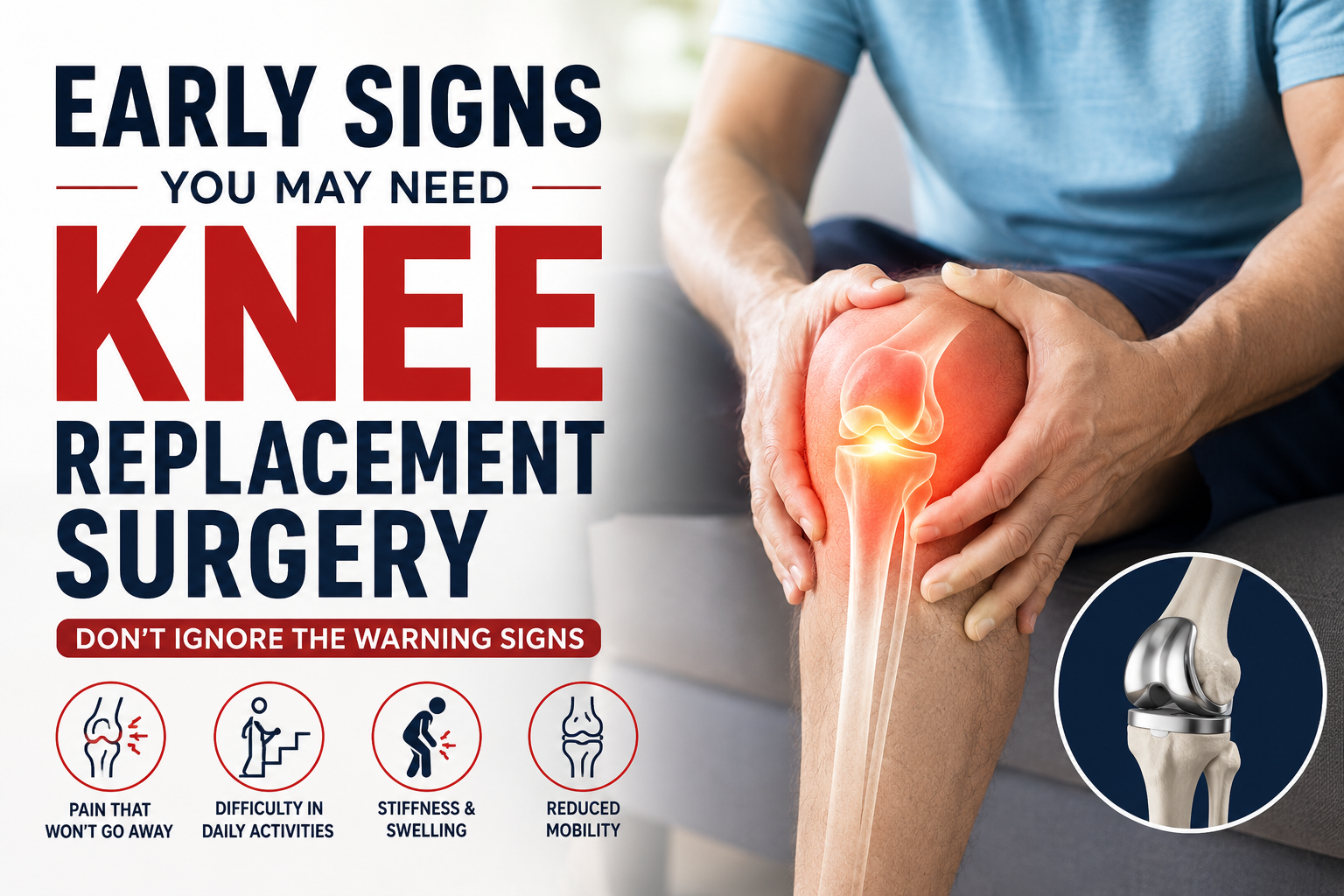
Knee pain is extremely common, especially as people get older or after previous injuries. Mild knee discomfort may improve with rest, exercise, physiotherapy, medication, or lifestyle changes. However, when knee damage becomes severe, everyday activities can become increasingly difficult.
For some patients, knee replacement surgery may eventually become an option when other treatments no longer provide adequate relief.
But how do you know when knee pain has progressed to the point where you should discuss knee replacement with an orthopedic surgeon?
There is no single symptom that automatically means you need surgery. The decision is usually based on a combination of your pain, mobility, knee damage, quality of life, and response to non-surgical treatments.
Here are some important signs that it may be time to get your knee evaluated.
1. Persistent Knee Pain That Does Not Improve
One of the most important warning signs is persistent knee pain.
Occasional discomfort after strenuous activity does not necessarily indicate the need for knee replacement. However, if your knee hurts regularly for weeks or months and the pain is gradually affecting your daily life, it deserves proper evaluation.
Arthritis is one of the most common causes of chronic knee pain. Osteoarthritis can cause the protective cartilage inside the knee to gradually wear down. As the condition progresses, the joint may become painful, stiff, and difficult to move.
Pain may initially occur only during activities such as walking long distances, climbing stairs, squatting, or exercising. Over time, it can become more frequent.
If your knee pain is becoming a regular part of your day, consult an orthopedic specialist rather than simply continuing to tolerate it.
2. Difficulty Walking
Walking is one of the simplest indicators of knee function.
If you find yourself avoiding walks because of knee pain, needing frequent breaks, or struggling to walk even short distances, your knee condition may be significantly affecting your mobility.
Severe arthritis can make simple activities such as walking from one room to another uncomfortable.
Some people gradually change the way they walk to reduce pain. They may limp, put more weight on the opposite leg, or avoid putting full pressure on the affected knee.
These changes can place additional stress on other joints and muscles.
An orthopedic evaluation can help determine whether the problem is caused by arthritis, cartilage damage, ligament problems, or another condition.
3. Pain While Climbing or Descending Stairs
Stairs place considerable demand on the knee.
You may notice that climbing stairs becomes difficult first, followed by difficulty going downstairs. You might need to hold onto the railing, take one step at a time, or avoid stairs completely.
This does not automatically mean you need knee replacement. However, if stair-related pain is persistent and significantly limits your activities, it is worth discussing with an orthopedic specialist.
According to the American Academy of Orthopaedic Surgeons, severe knee pain or stiffness that interferes with activities such as walking and climbing stairs can be one of the reasons a surgeon may consider total knee replacement.
4. Difficulty Getting Up From a Chair
Another common sign of advanced knee problems is difficulty standing up from a chair.
You may find yourself using your hands to push yourself upward, needing extra time to stand, or experiencing sharp pain when straightening the knee.
This can happen because arthritis may cause pain, stiffness, weakness, and reduced movement around the joint.
If getting in and out of chairs, cars, or beds has become increasingly difficult, your knee condition may be affecting your functional independence.
5. Knee Pain at Night
Knee pain that occurs after a busy day is common. However, pain that regularly wakes you during the night or continues even while resting can be more concerning.
Severe knee arthritis may cause pain even when you are sitting or lying down.
When pain interferes with sleep, it can affect your energy, mood, concentration, and overall quality of life.
If you regularly experience knee pain at rest or at night, speak with an orthopedic specialist about the possible causes and treatment options.
6. Persistent Swelling and Inflammation
Swelling is another symptom that should not be ignored.
A damaged or arthritic knee can become inflamed, leading to swelling around the joint. Some patients notice swelling after activity, while others experience more persistent swelling.
If your knee remains swollen despite rest, medication, or other conservative treatments, further evaluation may be necessary.
However, knee swelling can have many causes. Arthritis is only one possibility. Injuries, inflammation, infection, and other conditions can also cause swelling.
That is why diagnosis is important before deciding on treatment.
7. Knee Stiffness Is Limiting Your Movement
Stiffness can be just as disabling as pain.
You may find it difficult to fully bend or straighten your knee. Simple movements such as sitting cross-legged, squatting, getting into a car, or putting on footwear may become difficult.
As arthritis progresses, the range of motion of the knee may decrease.
Reduced movement can also contribute to muscle weakness and further difficulty with everyday activities.
A combination of physical examination and imaging, such as X-rays when appropriate, can help your orthopedic surgeon understand the condition of your knee.
8. Your Knee Looks Bowed or Deformed
Advanced arthritis can sometimes change the alignment or appearance of the knee.
Some people develop a bow-legged appearance, while others may develop an inward alignment of the knees.
A visible deformity can occur when the joint surfaces become severely damaged and the normal alignment of the leg changes.
Knee deformity is one of the factors orthopedic surgeons consider when evaluating whether total knee replacement may be appropriate.
9. Conservative Treatments Are No Longer Providing Enough Relief
Knee replacement is generally not the first treatment for knee arthritis.
Depending on your condition, your doctor may initially recommend treatments such as:
- Activity modification
- Physiotherapy
- Strengthening exercises
- Weight management
- Pain-relieving medications
- Anti-inflammatory medications when appropriate
- Walking aids
- Injections in selected patients
- Other non-surgical approaches
If these treatments provide good relief, surgery may not be necessary.
However, if your symptoms remain severe despite appropriate non-surgical treatment, your orthopedic surgeon may discuss surgical options.
The AAOS notes that failure to substantially improve with treatments such as medication, injections, physical therapy, or other procedures can be one factor considered when recommending total knee replacement.
10. Your Daily Life Is Becoming Smaller
Perhaps the most important question is not simply, “How much does my knee hurt?”
Instead, ask:
“What can I no longer do because of my knee?”
Have you stopped going for walks?
Do you avoid family outings because you cannot walk comfortably?
Have you stopped playing your favorite sport?
Do you avoid stairs?
Are you finding it difficult to work?
Are you struggling with household activities?
Are you sleeping poorly because of knee pain?
When knee problems begin controlling your lifestyle, it may be time for a comprehensive orthopedic assessment.
Does Everyone With Severe Knee Pain Need Knee Replacement?
No.
Knee replacement is not automatically required just because an X-ray shows arthritis or because someone has knee pain.
The decision is individualized.
Your orthopedic surgeon may consider:
- Severity of pain
- Degree of joint damage
- Functional limitations
- Knee deformity
- Range of motion
- Muscle strength
- Response to non-surgical treatment
- Overall health
- Your activity requirements
- Your expectations from surgery
Age alone does not determine whether someone should undergo knee replacement. The AAOS states that recommendations are primarily based on pain and disability rather than age.
What Happens During Knee Replacement?
A total knee replacement is more accurately described as resurfacing the damaged portions of the knee joint.
During surgery, damaged cartilage and a small amount of underlying bone are removed. Metal components are used to recreate the surfaces of the femur and tibia, with a medical-grade plastic spacer placed between them. The kneecap may also be resurfaced depending on the individual case.
The goal is to reduce pain, improve function, correct significant deformity when present, and help the patient return to normal daily activities.
What Can You Expect After Knee Replacement?
Recovery varies between individuals.
Physical therapy and regular exercises are important parts of recovery. Patients typically begin moving and walking soon after surgery under the guidance of their medical team.
The rehabilitation program focuses on restoring:
- Knee movement
- Leg strength
- Balance
- Walking ability
- Functional independence
The AAOS notes that regular exercise and gradual return to everyday activities are important for recovery after knee replacement.
Many patients gradually return to activities such as walking, swimming, cycling, and other lower-impact exercises after appropriate recovery and medical clearance.
High-impact activities may place additional stress on the implant and are generally approached cautiously.
When Should You See an Orthopedic Surgeon?
You should consider an orthopedic evaluation if you have:
- Persistent knee pain
- Pain at rest or at night
- Difficulty walking
- Difficulty climbing stairs
- Recurrent swelling
- Increasing stiffness
- Reduced knee movement
- Knee deformity
- Difficulty performing daily activities
- Symptoms that are not improving with conservative treatment
Early evaluation does not mean you will need surgery.
In many cases, the purpose of an orthopedic consultation is to determine the cause of your symptoms and identify the least invasive treatment that can provide meaningful improvement.
Final Thoughts
Knee replacement surgery is a major decision, but it can be an effective treatment for carefully selected patients with severe knee damage and significant pain or disability.
The key is not to decide based on pain alone.
If knee pain is preventing you from walking, sleeping, working, exercising, or enjoying everyday life, it may be time to discuss your symptoms with an orthopedic specialist.
A proper examination and appropriate imaging can help determine whether your knee can still be managed conservatively or whether surgical treatment should be considered.
Do not ignore persistent knee pain simply because you think it is a normal part of aging. Getting the right diagnosis is the first step toward getting the right treatment.
Medical disclaimer: This article is for general educational purposes and does not replace a personal medical examination or advice from a qualified orthopedic professional. Treatment decisions should be made based on an individual’s clinical condition.